Why your nutritional needs change every two weeks
Insulin sensitivity — the body's ability to use carbohydrates efficiently — is measurably different in the follicular phase versus the luteal phase. Metabolic rate increases by 200 to 300 calories per day in the luteal phase due to progesterone's thermogenic effect. Appetite increases with it — a physiological signal, not a psychological one. The hormonal environment the body operates in changes every two weeks. Nutrition that ignores this is leaving results on the table.
Research published in the American Journal of Clinical Nutrition confirmed that resting metabolic rate in the luteal phase is measurably higher than in the follicular phase — which is why eating more before your period is not a discipline failure but a biological response to a real energy demand.
Source: Solomon et al., Luteal phase metabolic rate changes in women — American Journal of Clinical Nutrition, PubMed.
Phase by phase — exactly what to eat
Menstrual phase (Days 1 to 5) — replenish.
Iron-rich foods are the priority: red meat, lentils, dark leafy greens, pumpkin seeds. Blood loss depletes iron stores and low ferritin is one of the most common causes of persistent fatigue in women — requested as a standalone blood test, not just haemoglobin. Vitamin C alongside iron foods significantly improves absorption. Warm anti-inflammatory meals — ginger, turmeric, salmon — support prostaglandin regulation and reduce cramping. Magnesium-rich foods — dark chocolate, avocado, leafy greens — support the nervous system in a low-hormone state.
Follicular phase (Days 6 to 13) — fuel performance.
This is your most metabolically efficient phase. Insulin sensitivity is highest — the body uses carbohydrates efficiently for energy and training. Increase complex carbohydrates to fuel the higher-intensity training this phase supports. Lean protein in every meal to support the anabolic environment estrogen creates. Cruciferous vegetables — broccoli, cauliflower, Brussels sprouts, kale — for DIM (diindolylmethane), which supports healthy estrogen metabolism through the liver. Fermented foods — kefir, kimchi, sauerkraut — for gut microbiome health, which directly affects estrogen clearance.
Ovulatory phase (Days 14 to 16) — light and anti-inflammatory.
Your shortest phase — eat lightly and cleanly. Zinc-rich foods — pumpkin seeds, beef, shellfish — support ovulation and testosterone balance. Antioxidant-rich foods protect against the mild inflammatory response ovulation itself triggers. Adequate hydration as the LH surge and estrogen peak both affect fluid balance. Fiber-rich vegetables support the clearance of estrogen as it begins its post-peak decline.
Luteal phase (Days 17 to 28) — eat more, eat smarter.
Progesterone raises metabolic rate by 200 to 300 calories. Eating more is physiologically appropriate. Complex carbohydrates — oats, sweet potato, quinoa, brown rice — support serotonin production through the tryptophan pathway as estrogen falls. This is the neurochemical mechanism behind carbohydrate cravings before your period — the body is seeking serotonin precursors, not comfort. Magnesium-rich foods throughout the luteal phase support GABA activity, sleep quality and premenstrual mood. Adequate protein — at least 1.6g per kg of bodyweight — maintains muscle despite progesterone's catabolic effect.
Reduce caffeine after day 20 — it amplifies cortisol sensitivity that is already elevated in this phase. Reduce alcohol in the premenstrual week — it disrupts sleep architecture, worsens premenstrual mood and inflames an already inflammatory state.
Cycle syncing and fat loss — how to make it work
The most effective approach to fat loss with cycle syncing is to align your caloric strategy with your hormonal environment rather than applying a uniform deficit across all four weeks.
In the follicular phase — with high insulin sensitivity and strong training response — a moderate caloric deficit (300 to 400 calories below maintenance) is well-tolerated and effective. The body is in its most efficient fat-mobilising state. Training response is strong. This is your optimal fat loss window.
In the luteal phase — with elevated metabolic rate, increased appetite and higher cortisol sensitivity — a caloric deficit triggers a stress response rather than a fat loss response. Cortisol rises to compensate for the energy gap, water retention increases, fat mobilisation slows. Eating at maintenance or a small surplus prevents this cortisol spike and produces better body composition outcomes over time than maintaining a deficit through a phase that resists it.
This is not intuitive. It feels like doing less. But the women who track their cycle alongside their body composition consistently find that eating more in the luteal phase accelerates fat loss in the follicular phase that follows — because the cortisol system is not fighting them.
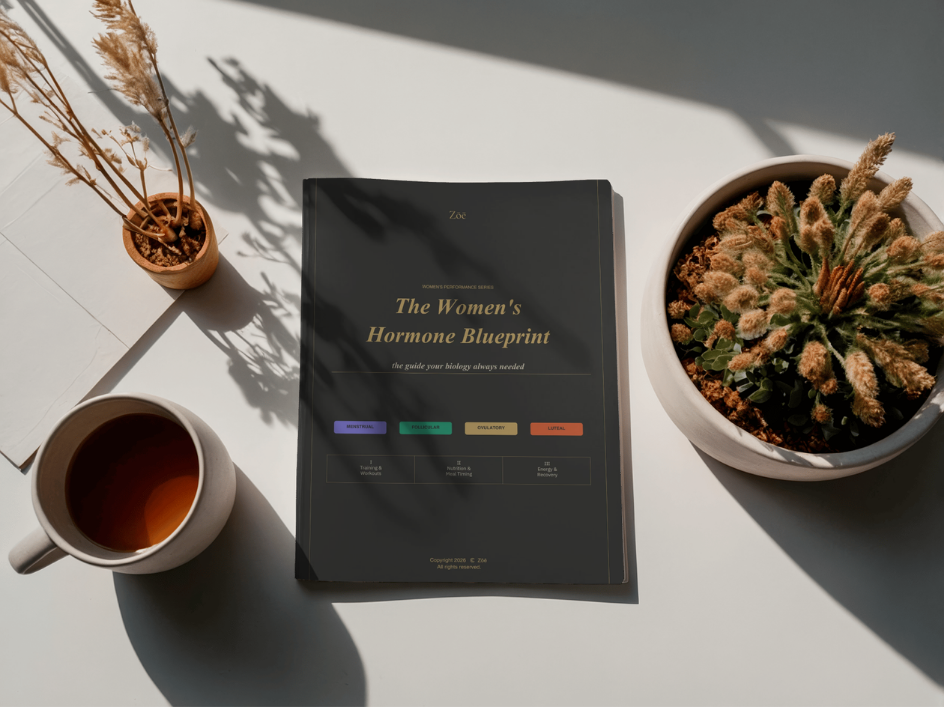
For the complete phase-specific nutrition system — with food lists, supplement timing, meal timing guidance and the science behind every recommendation — The Women's Hormone Blueprint covers all four phases in detail. Combined with the daily tracking practice of The Aligned Woman Journal, this becomes the complete system for understanding how your body responds to food across the cycle.