"Hormone balance" — what it actually means
The phrase "balance your hormones" is everywhere in wellness culture. It is also almost never defined precisely — which makes it easy to sell supplements that do nothing and equally easy to dismiss real, evidence-backed interventions as pseudoscience.
Hormones in the female body do not sit at a single "balanced" level. They cycle. Estrogen rises and falls across 28 days. Progesterone rises after ovulation and drops before menstruation. Testosterone peaks briefly at ovulation. Cortisol follows a daily rhythm that is disrupted by stress, poor sleep and over-training. The goal is not to flatten this variation — it is to support the body's ability to cycle without interference from nutritional deficiencies, chronic cortisol overload, poor sleep or inadequate recovery.
When women say they want to "balance their hormones," what they usually mean is: fewer premenstrual symptoms, more stable energy across the month, clearer skin, better sleep, and a body that feels less like it is working against them. All of these are achievable through evidence-based lifestyle and nutritional changes — not by buying a supplement labeled "hormone balance."
The supplements with actual evidence — and the ones without
Magnesium glycinate — the strongest evidence. Magnesium is a cofactor in over 300 enzymatic processes including cortisol regulation, GABA receptor function and progesterone synthesis. Research consistently shows that magnesium deficiency worsens PMS symptoms, disrupts sleep and amplifies cortisol response. Magnesium glycinate specifically — at 375mg daily in the luteal phase — has demonstrated measurable reductions in anxiety, mood symptoms, cramping and sleep disruption in multiple clinical studies. This is not a wellness trend. It is one of the most replicated nutritional interventions in women's health research.
Source: Fathizadeh et al., Evaluating the effect of magnesium and magnesium plus vitamin B6 supplement on the severity of premenstrual syndrome — PubMed.
Vitamin B6 — serotonin support as progesterone falls. B6 is a cofactor in the conversion of tryptophan to serotonin. As estrogen drops in the premenstrual week, serotonin production decreases with it. B6 at 50 to 100mg daily supports serotonin synthesis and has shown significant reductions in premenstrual depression and irritability in randomised controlled trials.
Source: Wyatt et al., Efficacy of vitamin B6 in the treatment of premenstrual syndrome — BMJ, PubMed.
Omega-3 fatty acids — prostaglandin regulation. Prostaglandins — compounds produced from arachidonic acid — are the primary driver of period cramps. Omega-3 fatty acids compete with arachidonic acid for the same enzymes, reducing prostaglandin production and with it, the severity of period pain and premenstrual inflammation. Daily omega-3 supplementation (at least 1g EPA + DHA combined) has consistent evidence for reduction of dysmenorrhoea.
Zinc — ovulation and sebum. Zinc regulates androgen activity and sebum production — making it particularly relevant for women experiencing hormonal acne and irregular cycles. Zinc also supports ovulation directly and is depleted by hormonal contraception.
What does not have strong evidence: Maca, ashwagandha for hormonal balance specifically (though it has evidence for cortisol), seed cycling, DIM supplements in isolation, most proprietary "hormone balance" blends. These are not necessarily harmful — they simply do not have the same quality of evidence as the above.
Food and the hormonal cycle — phase by phase
No single food balances hormones. But food choices across the cycle can significantly support the body's hormonal environment — reducing cortisol, supporting estrogen metabolism and providing the raw materials the body needs in each phase.
Cruciferous vegetables — broccoli, cauliflower, Brussels sprouts, kale — contain a compound called indole-3-carbinol, which the body converts to DIM (diindolylmethane). DIM supports the liver's ability to metabolise and clear estrogen, promoting healthy estrogen ratios. Particularly important in the follicular phase when estrogen is rising. Read more in our complete cycle nutrition guide.
Complex carbohydrates in the luteal phase support serotonin production through the tryptophan pathway. Oats, sweet potato, quinoa and brown rice eaten in the premenstrual week directly support mood — not through a vague "comfort food" mechanism, but through a specific neurochemical one. This is why carbohydrate cravings before your period are not weakness — they are your body seeking serotonin precursors.
Iron-rich foods after menstruation. Blood loss depletes iron stores and low ferritin — the stored form of iron — is one of the most consistently overlooked causes of fatigue in women of reproductive age. Red meat, lentils, dark leafy greens and pumpkin seeds post-period replenish what menstruation removes.
Training, sleep and cortisol — the lifestyle piece
Hormonal balance is not achieved through supplements alone. Cortisol — the primary stress hormone — is the single biggest disruptor of the female hormonal cycle. Chronically elevated cortisol competes with sex hormones for the same precursor molecule (pregnenolone), suppresses ovulation and amplifies premenstrual symptoms. Managing cortisol is therefore central to any hormonal health strategy.
Cycle-aware training is the most practical cortisol management tool for active women. High-intensity training in the follicular and ovulatory phases — when the hormonal environment supports recovery — and lower-intensity training in the luteal phase when cortisol sensitivity is elevated. This is not about training less overall. It is about not applying a uniform cortisol stimulus to a body that responds differently to that stimulus depending on the week. Read more about training by hormonal phase.
Consistent sleep timing stabilises the cortisol-melatonin axis. Cortisol should peak on waking and decline through the day. Irregular sleep times fragment this rhythm, keeping cortisol elevated in the evening and suppressing melatonin. Sleep quality also drops measurably in the luteal phase — read why and what to do about it here.
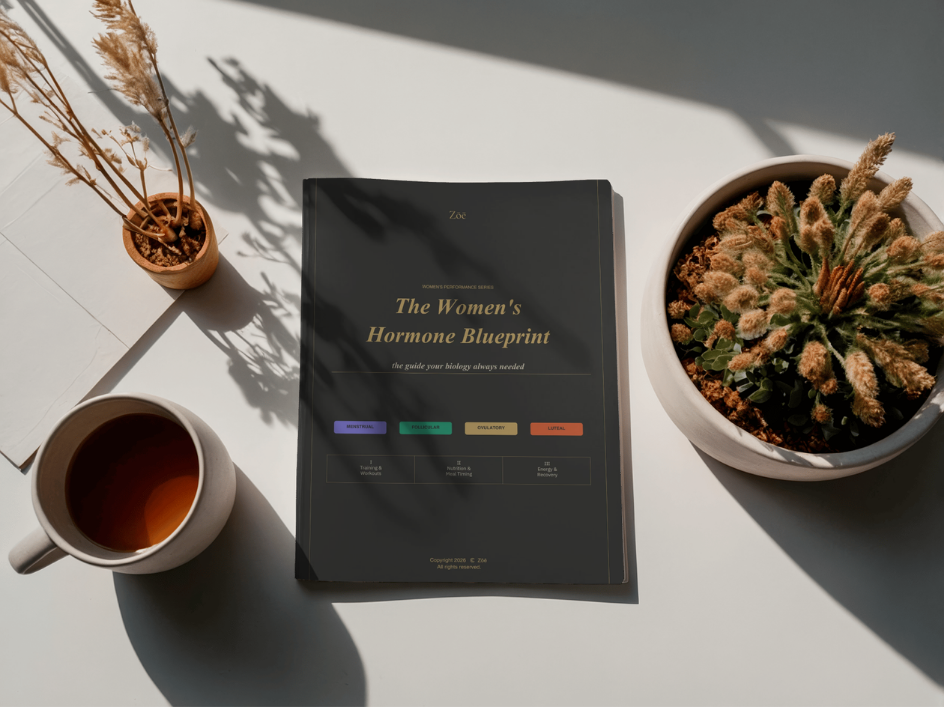
For the complete system — training protocols, nutrition timing, supplement schedule and energy management mapped to all four phases — The Women's Hormone Blueprint covers all of it in 60 pages. It is the practical application of everything on this page, built into a guide you can follow starting this cycle.