The mechanism — why the same deficit stops working
In the luteal phase — the two weeks between ovulation and your next period — three things happen simultaneously that change your metabolic environment completely.
One: progesterone raises your basal metabolic rate. Research published in the American Journal of Clinical Nutrition found that women's resting metabolic rate increases by approximately 200 to 300 calories per day in the luteal phase compared to the follicular phase. This means your body genuinely needs more fuel — and the increased appetite you experience is a physiological signal, not a psychological weakness.
Source: Solomon et al., American Journal of Clinical Nutrition — PubMed reference.
Two: insulin sensitivity drops. In the follicular phase, insulin sensitivity is at its highest — your body uses carbohydrates efficiently, energy is readily available and fat mobilisation is easier. In the luteal phase, progesterone reduces insulin sensitivity significantly. The same meal that was metabolised cleanly in week two now produces a larger insulin response, stores more glycogen and makes fat oxidation harder.
Three: cortisol sensitivity increases. The luteal phase raises baseline cortisol reactivity — meaning the same stress (including the stress of a caloric deficit or a hard training session) produces a larger cortisol response than it would earlier in the cycle. Higher cortisol promotes water retention, suppresses fat mobilisation and increases cravings for energy-dense foods.
Why the same deficit fails — the two-week cycle explained
Most fat loss plans are built on a single daily caloric target. The problem for women is that the hormonal environment that governs how that target is processed changes significantly every two weeks.
In the follicular phase — days 6 to 13 — insulin sensitivity is high, estrogen supports fat oxidation, training performance is strong and recovery is efficient. A moderate deficit in this phase produces real results because the body is metabolically primed for fat loss.
In the luteal phase — days 17 to 28 — the same deficit triggers a stress response. Cortisol rises to compensate for the energy gap, water is retained as a result, fat mobilisation slows, and training performance declines as progesterone's catabolic effect reduces muscle protein synthesis efficiency. The scale stops moving — or moves in the wrong direction — despite identical effort.
What actually works — phase-specific fat loss for women
Follicular phase (Days 6 to 13) — optimize for fat loss. This is your most metabolically favorable window. Insulin sensitivity is high, estrogen supports fat oxidation and training response is strongest. Use this phase for higher intensity training, moderate caloric deficit and higher carbohydrate intake (which your body handles efficiently). Push your sessions. Your results will reflect the hormonal environment.
Ovulatory phase (Days 14 to 16) — peak performance. Your shortest phase. Use it for your most demanding sessions — personal records, high output work, peak intensity. Eat to fuel performance. This is not the time to restrict.
Luteal phase (Days 17 to 28) — maintain, do not restrict. Eat more — specifically complex carbohydrates, which support serotonin production and stabilize blood sugar as progesterone rises. Reduce training intensity gradually through the phase. Prioritize sleep and magnesium glycinate 375mg daily to manage cortisol. A small caloric surplus in this phase is physiologically appropriate and will not derail fat loss progress — it will support it by preventing the cortisol spike that comes from restriction.
Menstrual phase (Days 1 to 5) — replenish. Iron-rich foods, gentle movement, adequate rest. This is not a fat loss phase. It is a recovery phase, and treating it as one produces better results in the follicular phase that follows.
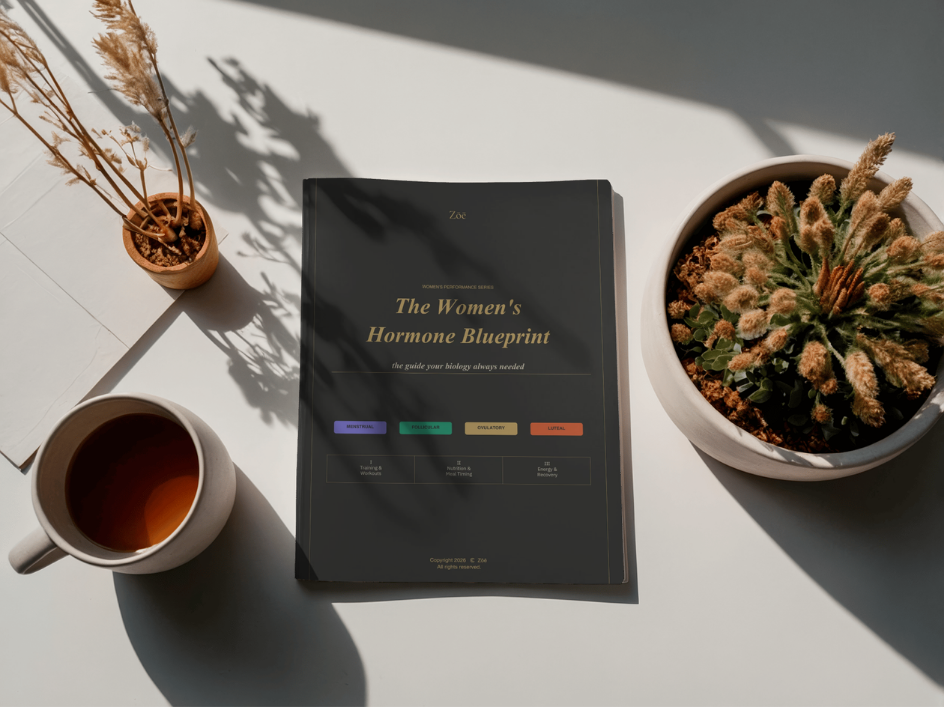
For the complete phase-specific training and nutrition system — including how to structure your training week across all four phases and exactly what to eat in each — The Women's Hormone Blueprint covers all of it. For the daily tracking practice that makes these patterns visible, The Aligned Woman Journal gives you 168 pages to record your energy, nutrition and cycle patterns across six complete cycles.