Why cycle syncing your training works — the science
The female hormonal cycle creates four distinct physiological environments across 28 days. Each one responds differently to training stimulus — in terms of muscle protein synthesis, neuromuscular efficiency, recovery capacity, cardiovascular output and cortisol response. A training plan that ignores this is operating on incomplete information.
Research from sports science journals including the Journal of Strength and Conditioning Research confirms that estrogen has measurable anabolic effects — supporting muscle protein synthesis and improving neuromuscular efficiency in the first half of the cycle. Progesterone in the luteal phase has the opposite effect — it is catabolic, increases protein breakdown and elevates cortisol sensitivity, making the same training session harder to recover from and less effective for body composition.
Source: Oosthuyse & Bosch, The effect of the menstrual cycle on exercise metabolism — Sports Medicine, PubMed.
Cycle syncing does not mean training less overall. It means applying maximum training stimulus when the body can use it most effectively, and reducing intensity when the hormonal environment makes recovery harder. The total training volume across the month does not decrease — it is distributed more intelligently.
The phase-by-phase workout plan — exactly what to do
Menstrual phase (Days 1 to 5) — rest and restore.
Hormones are at their lowest. The nervous system turns inward. This is not a training phase — it is a recovery phase. Movement is beneficial but intensity should be minimal. Walking, gentle yoga, restorative stretching, light swimming. Focus on blood flow rather than output. Iron-rich nutrition and adequate rest prepare the body for the strong training weeks ahead.
On days 4 to 5 as energy begins returning, you can introduce light resistance work — bodyweight movements, low-load exercises — to ease back into training before the follicular phase begins.
Follicular phase (Days 6 to 13) — build and push.
This is your strongest training phase. Estrogen rises steadily, supporting muscle protein synthesis, improving neuromuscular efficiency and enhancing recovery. Insulin sensitivity is at its peak — carbohydrate fueling is most effective in this window. Try new movements. Push for progressive overload. Schedule your most demanding sessions here.
Ideal follicular phase training: heavy compound strength training (squats, deadlifts, bench, rows), high-intensity interval training, running tempo work, progressive overload sessions. This is the phase where personal records are most achievable.
Ovulatory phase (Days 14 to 16) — peak performance.
Your shortest phase and your most powerful window. Estrogen peaks. Testosterone rises briefly. Peak cognitive and physical performance. Neuromuscular efficiency is highest. This is the window for personal records, maximum intensity sessions, competitive events and your most demanding physical output of the month.
Ideal ovulatory phase training: maximum effort sessions, competition, high-output HIIT, peak strength testing. Three days — use them.
Early luteal phase (Days 17 to 22) — moderate and maintain.
Progesterone rises. Recovery slows. The training environment becomes less anabolic. Body temperature is slightly elevated. Maintain training but reduce intensity from your follicular peak. Moderate resistance training with adequate rest between sessions. Continue strength work at 75 to 85% of your follicular intensity.
Late luteal phase (Days 23 to 28) — recover and protect.
This is the most misunderstood training window. Progesterone peaks and then drops sharply. Cortisol sensitivity is at its highest. High-intensity training in this window produces more cortisol for less training benefit — actively working against body composition and recovery. Shift to lower intensity: Pilates, yoga, moderate walking, light resistance work.
This is not detraining. It is intelligent programming. The rest in this phase is what makes the follicular phase training more effective.
Practical programming — a full month mapped out
Here is a template for organizing your training week across the cycle. Adjust to your specific schedule — the principle matters more than the exact days.
Days 1 to 5: Gentle movement only. Walk daily. Restorative yoga 2x. Light resistance from day 4.
Days 6 to 13: 4 to 5 training sessions. Heavy compound strength 3x. HIIT or tempo cardio 1 to 2x. Push progressive overload. Try new lifts.
Days 14 to 16: 2 to 3 sessions. Maximum intensity. Test your limits. Best conditions for personal records.
Days 17 to 22: 3 to 4 sessions. Moderate intensity. Strength at 75 to 85% follicular load. Steady-state cardio instead of HIIT.
Days 23 to 28: 2 to 3 sessions. Low intensity. Yoga, Pilates, walking, light resistance. Prioritize recovery and magnesium glycinate 375mg daily.
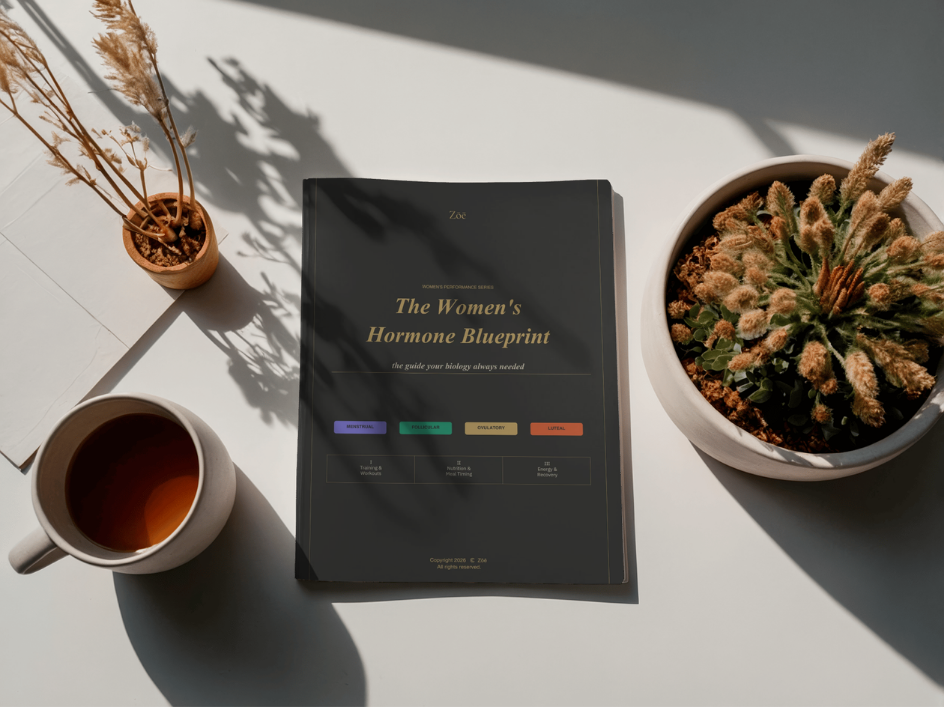
For the complete phase-specific training system including exercise selection, loading parameters, nutrition timing and recovery protocols for each phase — The Women's Hormone Blueprint maps all of this in a 60-page guide. For the daily tracking practice — noting energy, training performance and cycle day — The Aligned Woman Journal is where this becomes real over six cycles.
Andreea Mighiu is a women's hormonal health educator and the founder of Zōē. She works alongside a registered dietitian and an endocrinologist to ensure content reflects current clinical understanding. She is an educator, not a physician — Zōē's content is designed to inform, not to replace personalised medical advice.
References
1. McNulty KL, et al. Menstrual Cycle Phase and Exercise Performance: systematic review and meta-analysis. Sports Medicine, 2020. pubmed.ncbi.nlm.nih.gov
2. Dietary energy intake across the menstrual cycle: a narrative review. 2023. pmc.ncbi.nlm.nih.gov
This article is educational and not a substitute for medical advice. Speak with a qualified clinician before making significant changes to diet, training, supplementation or medication.