If estrogen is the hormone of the first half of your cycle — building, rising, energising — then progesterone is the hormone of the second half: steadying, calming, preparing. Most people only know it as "the pregnancy hormone," but that's a fraction of the story. Understanding what progesterone actually does explains so much about why you feel the way you do in the back half of your month.
Where progesterone comes from — and when
Progesterone is made mainly by a temporary structure called the corpus luteum, which forms in the ovary right after you ovulate. This is the key timing point that confuses a lot of people: progesterone rises after ovulation, not during it. In the first half of your cycle (the follicular phase), progesterone is low while estrogen leads. After ovulation, the corpus luteum starts producing progesterone, which dominates the luteal phase — the second half. It peaks in the mid-luteal phase, then falls in the days before your period if you're not pregnant, and that fall is what triggers menstruation.
Source: Progesterone: Natural Function, Levels & Side Effects — Cleveland Clinic. Progesterone is produced by the corpus luteum after ovulation and dominates the luteal phase.
Its main job — preparing for pregnancy
Progesterone's name is a clue: "pro-gestation." Its central role is to prepare and maintain the lining of your uterus so that, if an egg is fertilised, it has a thick, nourishing place to implant and grow. If pregnancy happens, progesterone helps sustain it in the early weeks. If it doesn't, progesterone drops, the lining sheds, and you get your period. This rise-and-fall is the rhythm behind your whole cycle.
The part most people miss — progesterone and your brain
Here's where it gets interesting. Progesterone doesn't just act on your uterus — it acts on your brain. When it reaches the brain, progesterone is converted into a compound called allopregnanolone, which calms the nervous system by enhancing GABA, your brain's main "quieting" signal. This is why the luteal phase can feel calmer, sleepier, and sometimes foggier, and it's the reason progesterone is so closely tied to sleep and that pre-period drowsiness.
Source: Administration of progesterone produces mild sedative-like effects — Psychoneuroendocrinology. Progesterone's metabolite allopregnanolone produces calming, sedative-like effects via GABA-A receptors.
Progesterone and estrogen — a partnership of opposites
Progesterone rarely works alone. So much of how you feel comes from the balance between progesterone and estrogen. Broadly, estrogen tends to be stimulating and building, while progesterone tends to be calming and steadying — and they're meant to rise and fall in a coordinated dance across your cycle. When that balance is off (for example, when progesterone is low relative to estrogen), it can show up as heavier periods, worse PMS, or other symptoms. We compare the two in detail in estrogen vs progesterone.
It also raises your body temperature
One more neat function: progesterone raises your basal body temperature slightly after ovulation. That small, sustained temperature rise is actually how many women confirm they've ovulated when tracking their cycle — it's progesterone leaving its signature.
What low progesterone can look like
Because progesterone does so much, low levels can show up in different ways: irregular periods, spotting before your period, short cycles, heavier or more symptomatic periods (when estrogen is relatively dominant), and difficulty maintaining early pregnancy. But here's the important caveat — most of these symptoms have several possible causes, and you can't diagnose low progesterone from symptoms alone. Only a doctor can confirm it, usually with a blood test timed to a specific point in your cycle.
Why understanding progesterone changes things
Once you know progesterone runs the second half of your cycle — calming your brain, building your uterine lining, raising your temperature, balancing estrogen — the luteal phase stops feeling mysterious. The sleepiness, the warmth, the slight slowing-down: that's progesterone doing its job. Working with that rhythm, rather than against it, is the whole idea behind cycle awareness.
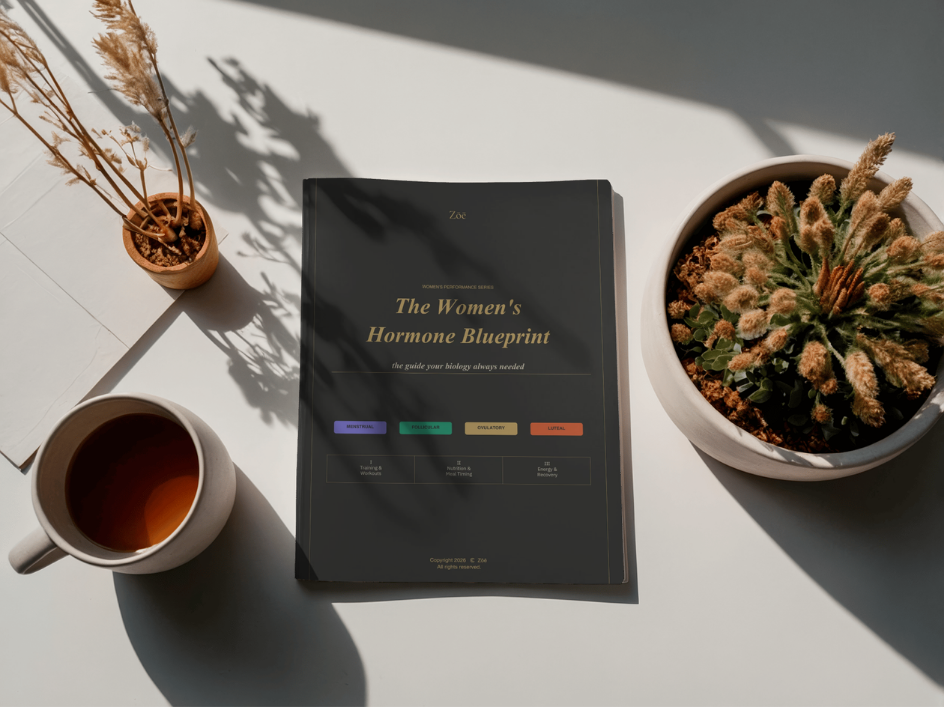
If you'd like to understand all four phases and how your hormones shape each one, The Women's Hormone Blueprint maps the full picture, and The Aligned Woman Journal helps you track your own patterns across six cycles.
Andreea Mighiu is a women's hormonal health educator and the founder of Zōē. She works alongside a registered dietitian and an endocrinologist to ensure content reflects current clinical understanding. She is an educator, not a physician — Zōē's content is designed to inform, not to replace personalised medical advice.
References
1. Progesterone: Natural Function, Levels & Side Effects. Cleveland Clinic. my.clevelandclinic.org
2. Administration of progesterone produces mild sedative-like effects in men and women. Psychoneuroendocrinology. sciencedirect.com
3. Allopregnanolone affects sleep in a benzodiazepine-like fashion. PubMed. pubmed.ncbi.nlm.nih.gov
This article is educational and not a substitute for medical advice. Questions about your hormone levels, testing, HRT or supplements should be discussed with a qualified healthcare provider.