If you only learn two hormones, learn these. Estrogen and progesterone are the two leads in the story of your cycle, and almost everything you feel across the month comes from their rise, their fall, and the balance between them. They're often spoken about as if they're interchangeable "female hormones," but they're really more like two dancers with opposite styles, taking turns to lead. Here's how they differ.
Estrogen — the builder
Estrogen is the hormone of the first half of your cycle, the follicular phase. Think of it as building and energising. It thickens the lining of the uterus in preparation for a possible pregnancy, and it rises steadily to a peak right around ovulation. Beyond reproduction, estrogen tends to support mood, energy, mental sharpness, skin, and even libido. When estrogen is rising, many women feel more outgoing, motivated and capable, which is why the first half of the cycle often feels like the stronger, brighter stretch.
Progesterone — the stabiliser
Progesterone is the hormone of the second half, the luteal phase. It's made after ovulation by the corpus luteum, and where estrogen builds and stimulates, progesterone calms and maintains. It holds the uterine lining in place in case of pregnancy, and it has a soothing effect on the brain — it's converted into allopregnanolone, which is why higher progesterone can make you feel calmer and sleepier. Progesterone also gently raises your body temperature after ovulation. The second half of the cycle often feels quieter, slower and more inward, and that's progesterone's signature. For the full picture, see what progesterone actually does.
Source: Progesterone: Natural Function, Levels & Side Effects — Cleveland Clinic. Progesterone and estrogen work together and balance each other across the cycle and in hormone therapy.
Side by side — the quick comparison
Here's the difference at a glance. Estrogen: dominates the first half, peaks at ovulation, builds the uterine lining, tends to energise and lift mood, supports skin and libido. Progesterone: dominates the second half, peaks mid-luteal, maintains the uterine lining, tends to calm and stabilise, supports sleep, raises body temperature slightly. Estrogen is the accelerator; progesterone is the brake. You need both, in rhythm.
When each is highest
The timing is the key to it all. Estrogen rises through the first half and peaks around ovulation, in the middle of your cycle. Progesterone stays low in the first half, then rises after ovulation and peaks in the mid-luteal phase. Both then fall in the days before your period, and that fall is what triggers menstruation and starts the cycle again. So your month has an estrogen-led first half and a progesterone-led second half, which is the foundation of cycle awareness and knowing when to push and when to rest.
How they balance each other
Here's the most important idea: estrogen and progesterone aren't rivals, they're partners. Progesterone balances some of estrogen's effects, and vice versa. So much of how you feel depends not on either hormone alone but on the ratio between them at any point in your cycle. This is also why they're used together in many forms of hormone therapy and contraception — they're designed to work as a pair.
What "estrogen dominance" means
You may have heard the term estrogen dominance. It describes a situation where estrogen is high relative to progesterone — either because estrogen is elevated or because progesterone is low. Because progesterone normally balances estrogen, a relative shortage of it can be linked to symptoms like heavier periods, worse PMS, breast tenderness and mood changes. It's a useful concept, but an imprecise one: these symptoms have many possible causes, so it's something to explore with a doctor rather than self-diagnose.
Why understanding both changes everything
Once you can feel the difference between your estrogen-led first half and your progesterone-led second half, your whole month stops being a mystery. The bright, capable days and the quiet, sleepy days aren't random moods — they're two hormones taking turns. Working with that rhythm is the heart of what we teach.
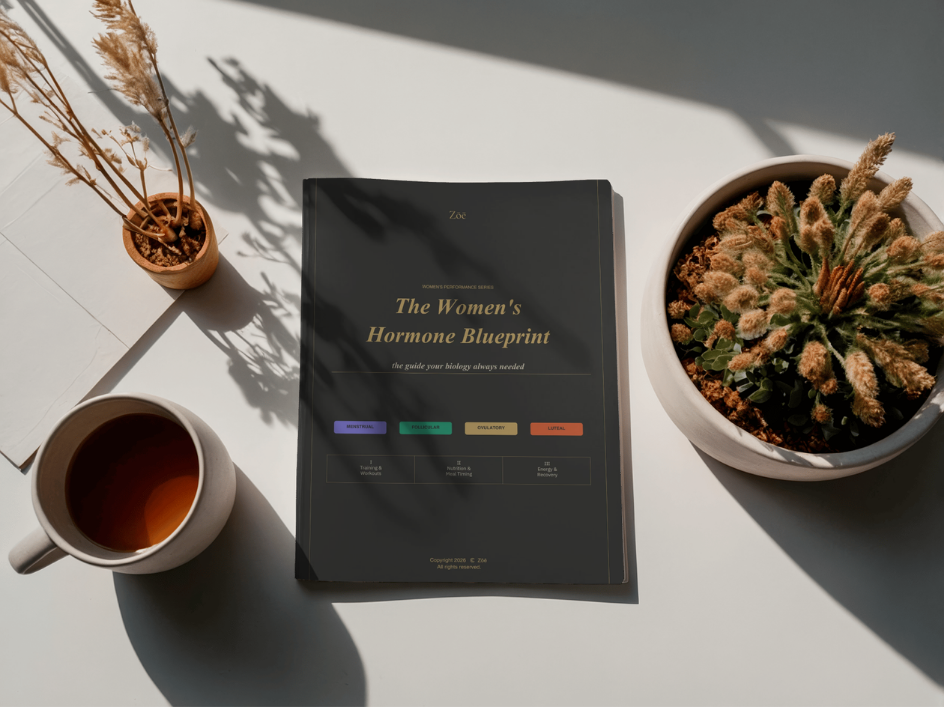
To go deeper into all four phases and exactly how to live with each one, The Women's Hormone Blueprint maps the full system, and The Aligned Woman Journal helps you track your own estrogen-and-progesterone rhythm across six cycles.
Andreea Mighiu is a women's hormonal health educator and the founder of Zōē. She works alongside a registered dietitian and an endocrinologist to ensure content reflects current clinical understanding. She is an educator, not a physician — Zōē's content is designed to inform, not to replace personalised medical advice.
References
1. Progesterone: Natural Function, Levels & Side Effects. Cleveland Clinic. my.clevelandclinic.org
2. Administration of progesterone produces mild sedative-like effects. Psychoneuroendocrinology. sciencedirect.com
This article is educational and not a substitute for medical advice. Questions about your own hormone levels or balance should be discussed with a qualified healthcare provider.