Your 20s — building the foundation that protects every decade after
The hormonal environment of the 20s is, in most women, the most consistent and robust of the reproductive decades. Estrogen cycles predictably. Progesterone produces a reliable luteal phase. Testosterone supports muscle building through each ovulatory peak. The HPO axis responds flexibly and recovers quickly from disruption.
The most important investment: muscle mass. The 20s are the best decade for building the muscle that will protect metabolic rate for the rest of your life. The anabolic environment of high, regular estrogen and monthly testosterone peaks supports muscle protein synthesis at a level that becomes progressively less available in subsequent decades. Every kilogram of muscle built in the 20s is metabolic currency for the 30s and 40s.
Bone density — the hidden priority. Peak bone density is established by approximately 25 to 30. The bone mass built in the 20s is the lifetime reserve. Estrogen's bone-protective effect is at its strongest. High-impact activity, adequate calcium, vitamin D and resistance training in this decade maximize the bone density peak that provides protection against osteoporosis when estrogen eventually declines.
The most valuable habit to start in the 20s: Cycle tracking. Establishing your baseline cycle pattern in the 20s makes changes in the 30s recognisable. The woman who has tracked her cycle for five years enters her 30s with data — not surprises.
Your 30s — the decade where the hormonal environment begins to shift
The 30s are the decade where the hormonal foundation begins to change — not suddenly, not dramatically, but measurably. Several things happen in parallel:
Ovarian reserve gradually declines from the late 20s. The cycle may shorten slightly as the follicular phase contracts. FSH begins to rise slightly. Estrogen production remains robust in most women but variation between cycles increases.
Cortisol sensitivity increases. Estrogen buffers the stress response — as it becomes more variable, cortisol sensitivity rises. The same training volume that recovered easily in the 20s may begin to feel like overtraining in the 30s. The same life stress produces a larger cortisol response. This is hormonal adaptation, not physical decline.
Muscle mass decline begins. Sarcopenia progresses at 3 to 5 percent per decade without deliberate resistance training. Women who have trained predominantly through cardio begin to notice body composition changes despite consistent effort. The answer is resistance training — adding and then prioritizing it in the 30s produces measurably better outcomes than maintaining cardio-dominant programs. Read more at why women gain weight in their 30s.
PMS may worsen. As the estrogen-progesterone ratio becomes more variable, the premenstrual hormonal drop can become more pronounced. This is often one of the earliest signals of the gradual transition that becomes perimenopause in the decade that follows.
Your 40s — navigating perimenopause with clarity
The 40s are the decade where perimenopause becomes a relevant and often lived experience for most women. Average menopause at 51 means perimenopause begins in the early to mid-40s for most women — though for some it begins in the late 30s and for others not until the late 40s. The experience varies enormously. Understanding the mechanism gives the woman in her 40s something she rarely receives: a map.
What is changing: Ovarian function becomes progressively less consistent. Some cycles produce adequate estrogen and progesterone — others are anovulatory. Estrogen levels fluctuate more dramatically. FSH rises. The characteristic symptoms of perimenopause — hot flushes, night sweats, sleep disruption, new anxiety, cycle irregularity — emerge from this increasing hormonal variability rather than from deficiency per se.
Training in the 40s. Resistance training becomes the single most important exercise category — for muscle mass maintenance as estrogen's anabolic support declines, for bone density maintenance as estrogen's bone protection reduces, for metabolic rate protection, for insulin sensitivity and for cortisol management. Chronic high-intensity cardio in the 40s produces compounding cortisol and muscle loss without the hormonal buffer of robust estrogen. The pivot from cardio-dominant to resistance-dominant training is the most important training decision of this decade. Read more at perimenopause symptoms in your 30s and 40s.
Nutrition in the 40s. Adequate protein becomes more critical — muscle protein synthesis efficiency declines with estrogen. Phase-specific carbohydrate management becomes essential as insulin sensitivity further decreases. Anti-inflammatory foods support the increased inflammation that accompanies estrogen variability. Bone-supporting calcium, vitamin D and K2 become the highest nutritional priorities they have yet been. Read more about belly fat and hormones in the 40s.
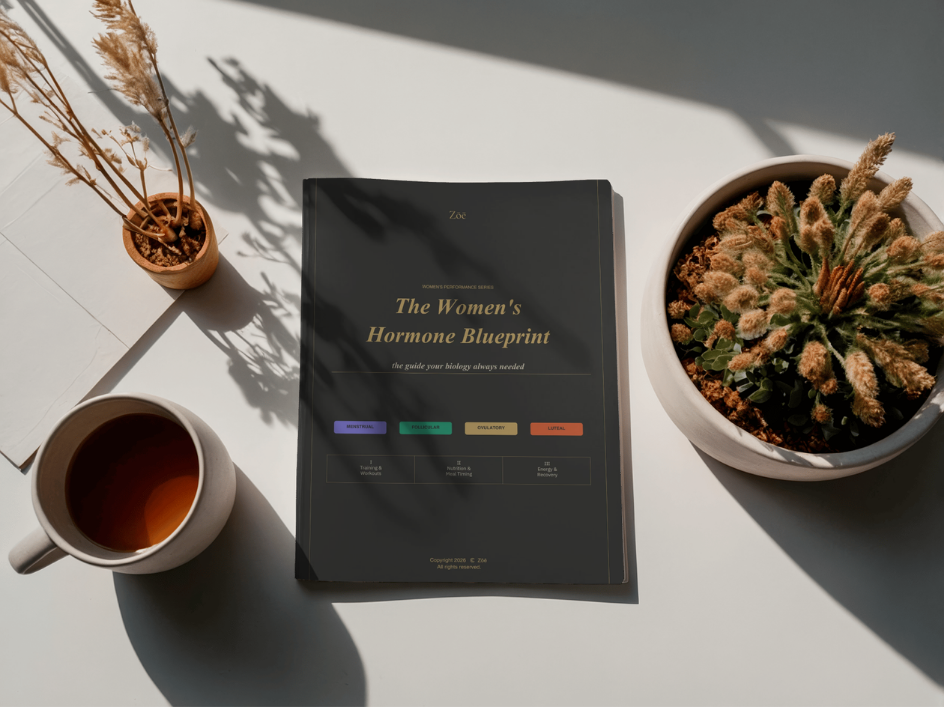
A note on the research behind this: The founder of Zōē spent years working with specialists across endocrinology, sports science and nutritional medicine — investing hundreds of thousands in clinical collaboration to build a complete picture of the female hormonal system. The Women's Hormone Blueprint is the practical result of that research, distilled into 60 pages every woman can use.
The Women's Hormone Blueprint covers the complete framework for training, nutrition and supplementation across all phases of the cycle — applicable in the 20s, 30s and 40s with the phase-specific awareness that makes the difference at every stage. For the daily tracking practice that makes patterns visible and changes real across six complete cycles, The Aligned Woman Journal gives you the daily structure to build that understanding systematically over time.