What perimenopause actually is — and when it starts
Perimenopause is not menopause. It is the hormonal transition that precedes it — the phase during which ovarian function begins to decline, estrogen and progesterone production becomes increasingly variable, and the menstrual cycle starts to change. This transition averages four to eight years and typically ends when a woman has gone twelve consecutive months without a period — the clinical definition of menopause.
The average age of menopause in the UK and US is 51. Which means perimenopause on average begins somewhere between 43 and 47. But this is an average — and the range is wide. Some women enter perimenopause in their late 30s, particularly those with a family history of early menopause, those who have experienced significant chronic stress, those who smoke, and those who have had certain gynaecological procedures.
Early perimenopause in the 30s is more common than medical discourse suggests and far more common than most women are prepared for. The symptoms are real, measurable and hormonal — but they are routinely attributed to stress, anxiety, burnout or depression by both women themselves and their healthcare providers.
The earliest signs — what to look for in your 30s
Cycle changes are the most reliable early indicator. A cycle that shortens — becoming 24 or 25 days when it was previously 28 to 30 — is one of the earliest measurable signs of perimenopause. The shortening happens because the follicular phase (the first half of the cycle) contracts as ovarian reserve declines and FSH rises to compensate. Cycles may also lengthen, skip, or become heavier than before.
Worsening premenstrual symptoms that were previously manageable. If your PMS has become significantly more severe — more emotional reactivity, worse sleep disruption, heavier periods, more intense fatigue — without a clear lifestyle explanation, changing estrogen and progesterone ratios may be the cause.
Sleep disruption that is new or different. Night sweats, more frequent waking, difficulty returning to sleep. Progesterone has a direct sedating and temperature-regulating effect — as it becomes more variable, sleep architecture is one of the first things affected.
Brain fog and cognitive changes that are persistent rather than cyclical. Estrogen directly supports acetylcholine production — the neurotransmitter most associated with memory and cognitive function. As estrogen becomes more variable, cognitive sharpness can fluctuate in ways that feel alarming and out of character.
Hot flushes or night sweats — often dismissed in the 30s because they are not expected. But vasomotor symptoms can occur in early perimenopause as estrogen fluctuates more dramatically between cycles.
What to do — the practical response
The most important first step is tracking. If your cycle pattern is changing, you need data — cycle length over at least three to six cycles, symptom patterns, sleep quality, energy levels. This data is what makes a GP or specialist appointment productive rather than vague. The daily tracking practice in The Aligned Woman Journal gives you exactly this structure across six complete cycles.
Request specific blood tests: FSH, oestradiol and LH on days 2 to 5 of your cycle. AMH for ovarian reserve. Full thyroid panel. Ferritin. These give you a baseline. Because hormones fluctuate during perimenopause, a single normal reading does not rule it out — repeat testing across multiple cycles gives a more complete picture.
The lifestyle interventions that most effectively support the perimenopausal transition mirror those that support the cycling female body at any age — with greater urgency. Magnesium glycinate 375mg daily. Adequate dietary protein for muscle maintenance as estrogen declines. Resistance training prioritized over high-intensity cardio. Sleep protection. Cortisol management.
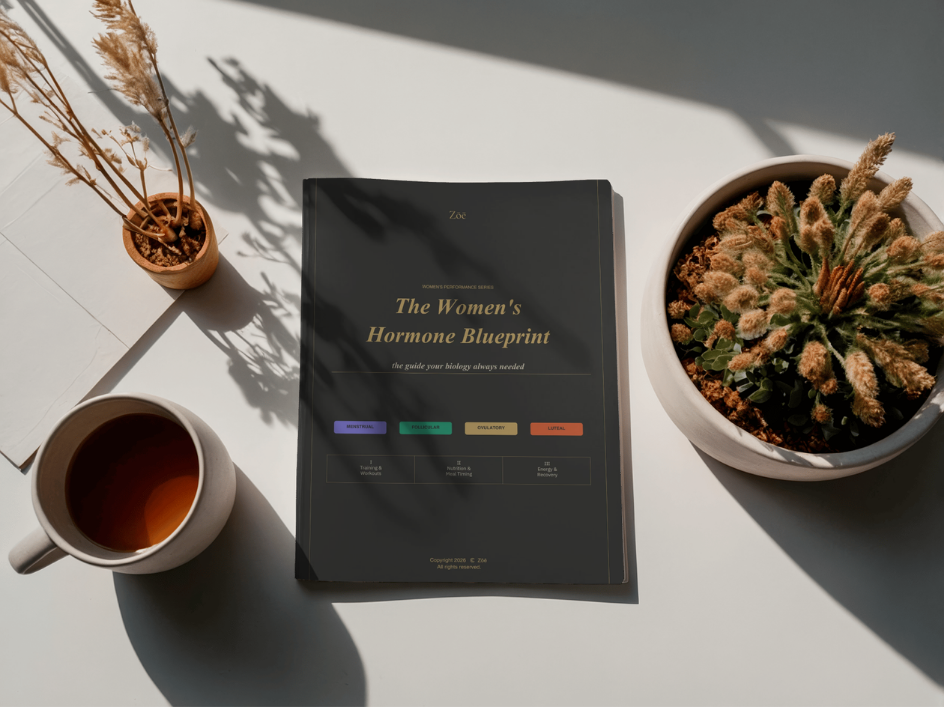
A note on the research behind this: The founder of Zōē spent years working with specialists across endocrinology, sports science and nutritional medicine — investing hundreds of thousands in clinical collaboration to build a complete picture of the female hormonal system. The Women's Hormone Blueprint is the practical result of that research, distilled into 60 pages every woman can use.
For the complete phase-specific framework — including how to adjust training, nutrition and supplementation as hormonal patterns change — The Women's Hormone Blueprint provides the science and the practical protocols every woman in this transition needs.