Most of us were taught the bare minimum about the menstrual cycle: you bleed once a month, the end. But your period is only one act in a four-part play that runs all month long, driven by a beautifully coordinated rise and fall of hormones. Once you can see the whole cycle, everything else — your energy, your skin, your mood, your cravings — starts to make sense. Let's walk through it.
The menstrual cycle, defined
The menstrual cycle is your body's monthly hormonal preparation for a possible pregnancy. It's counted from the first day of one period to the first day of the next. On average it's about 28 days, but anywhere from 21 to 35 days is completely normal — the "28 days" everyone quotes is just an average, not a rule. Across the cycle, hormones rise and fall in sequence to build up the uterine lining, release an egg, and then either support a pregnancy or shed the lining (your period) and start again.
Source: cycle length norms per Mayo Clinic and clinical guidance. Normal cycles range roughly 21 to 35 days.
The four phases
The cycle has four phases. Think of them as two long halves with a pivotal moment in the middle.
1. The menstrual phase (your period). This is day one of your cycle. Hormones are low, and the uterine lining built up last cycle sheds as your period, typically lasting 3 to 7 days. It's a natural reset.
2. The follicular phase. Overlapping with and following your period, estrogen rises as your ovaries prepare an egg. Estrogen rebuilds the uterine lining and tends to lift energy and mood. This is the building, brightening first half.
3. Ovulation. Around the middle of your cycle, a surge of luteinizing hormone releases a mature egg. This is the fertile peak, and estrogen and testosterone are at their highest. (We explain this fully in what ovulation is.)
4. The luteal phase. After ovulation, progesterone rises, maintaining the uterine lining in case of pregnancy and bringing a calmer, sometimes sleepier, more inward quality. If there's no pregnancy, progesterone falls, and that drop triggers your next period, starting the cycle over.
Source: Progesterone & the menstrual cycle — Cleveland Clinic; Ovulation — Cleveland Clinic. The cycle moves through menstruation, the follicular phase, ovulation and the luteal phase.
How long should it all take?
A normal cycle runs 21 to 35 days. Within that, the luteal phase (after ovulation) tends to be fairly consistent at around 12 to 14 days, while the follicular phase (before ovulation) is what varies most — which is why your ovulation day shifts if your cycle is shorter or longer. Cycle length can also change from month to month, and is naturally more variable in teenagers and during perimenopause.
A common little mystery — "why do I pee so much on my period?"
Here's one the textbooks never explain. If you find yourself running to the loo more around your period, there's a real reason. During the luteal phase, progesterone causes your body to hold onto extra fluid (hello, period bloating). Then, right before and during your period, progesterone drops — and your body releases all that retained fluid, which means more trips to the bathroom. On top of that, the same prostaglandins that cause cramps can affect the bladder, and your cramping, contracting uterus sits right next to your bladder, which can make you feel like you need to go more often. It's a normal, if annoying, part of the period package.
(One caveat: if peeing comes with burning or pain, that's not a period thing — it can signal a urinary tract infection and is worth getting checked.)
Why understanding your cycle changes everything
Once you can see your cycle as four phases rather than just "period or not period," your whole month becomes readable. The energetic days, the sleepy days, the cravings, the mood shifts — they stop being random and start being a rhythm you can anticipate and work with. That's the entire idea behind cycle awareness: not fighting your body, but moving with it.
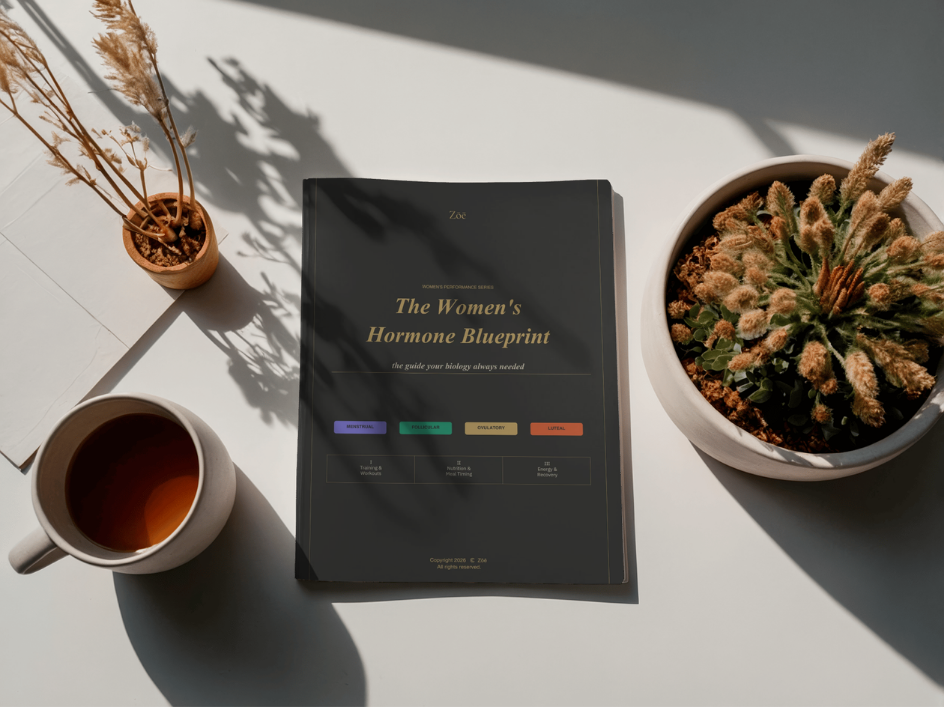
If you'd like the full, practical map of how to eat, train and live in each phase, The Women's Hormone Blueprint lays it all out, and The Aligned Woman Journal helps you track your own cycle across six months so you learn your personal pattern.
Andreea Mighiu is a women's hormonal health educator and the founder of Zōē. She works alongside a registered dietitian and an endocrinologist to ensure content reflects current clinical understanding. She is an educator, not a physician — Zōē's content is designed to inform, not to replace personalised medical advice.
References
1. Progesterone: Natural Function, Levels & Side Effects. Cleveland Clinic. my.clevelandclinic.org
2. Ovulation: Calculating, Process, Pain & Other Symptoms. Cleveland Clinic. my.clevelandclinic.org
3. Ovulation signs: When is conception most likely? Mayo Clinic. mayoclinic.org
This article is educational and not a substitute for medical advice. For concerns specific to your cycle or health, please speak with a qualified healthcare provider.