What actually controls your recovery speed
Muscle repair depends heavily on estrogen, which has a genuine anti-inflammatory and muscle-protective effect. In the follicular phase, when estrogen is rising, women tend to recover faster from the same training load, with less prolonged soreness. In the luteal phase, as progesterone rises and estrogen eventually falls, that protective effect fades — inflammation resolves more slowly, and delayed-onset muscle soreness can genuinely last longer for the identical session.
Why the same session can feel different week to week
This is not inconsistency in your training or a sign you are losing fitness. It is your baseline inflammatory and repair capacity shifting on a predictable schedule. A session in week one of your cycle and the identical session in week three are, physiologically, not equivalent demands on your body — even though the movement pattern and load are exactly the same.
How to train around slower recovery instead of ignoring it
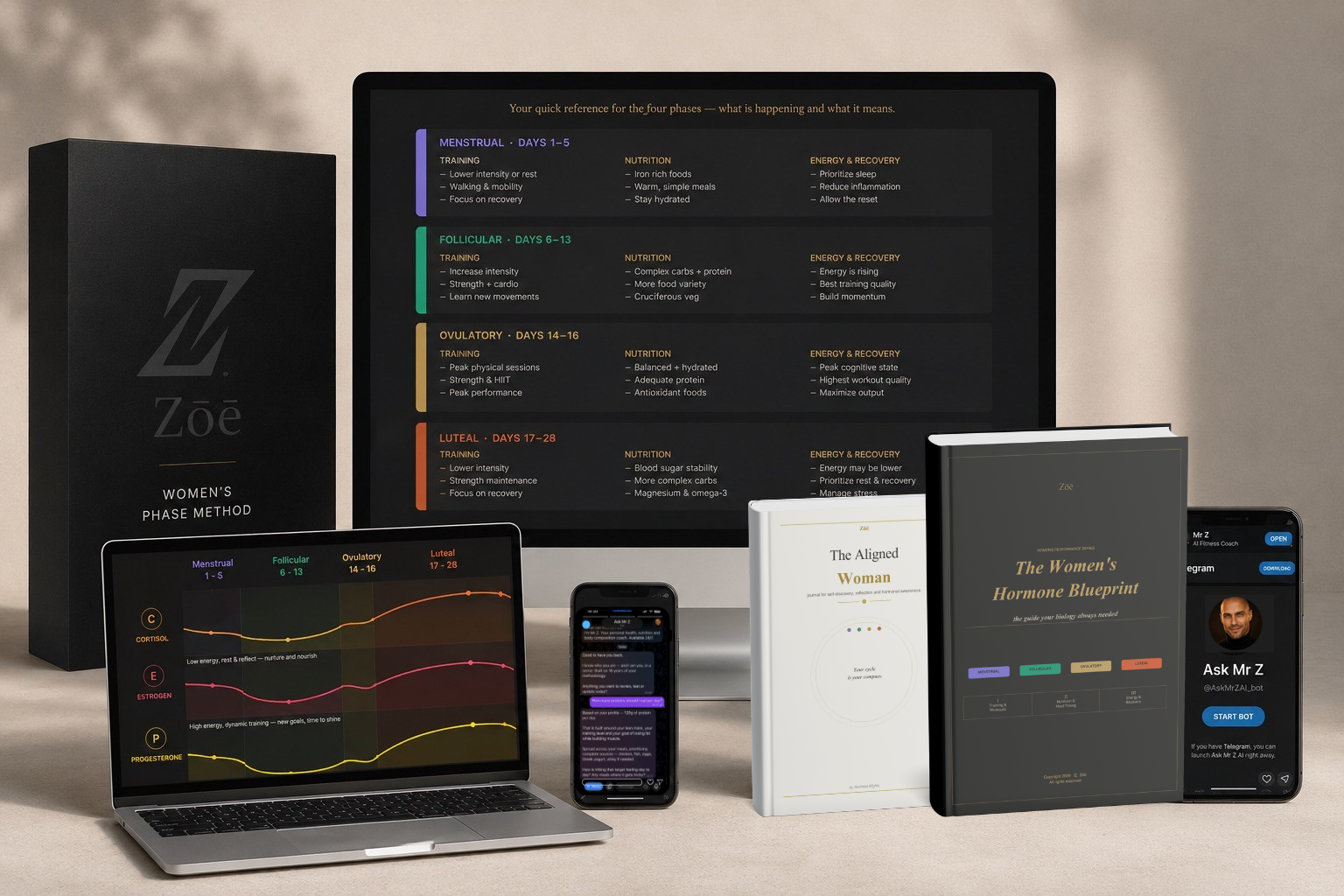
Rather than pushing the same volume regardless of phase, the more effective approach is to front-load higher-volume, higher-intensity training in the follicular phase when recovery is fastest, and shift toward moderate loads with more built-in rest in the luteal phase. This is not "training less" — it is placing the hardest stimulus where your body can actually absorb it. This exact logic is the backbone of how Zōē structures a 12-week block.

Alongside Andreea and Francesco's direct coaching, The Zōē Method includes access to Mr Z — an AI coaching assistant built by Francesco Zen on ZTraining's 18-year coaching methodology, available via Telegram between sessions for real-time questions on training days, travel, and nutrition choices.
Andreea Mighiu is a women's hormonal health educator and the founder of Zōē. She works alongside a registered dietitian and an endocrinologist to ensure content reflects current clinical understanding. She is an educator, not a physician — Zōē's content is designed to inform, not to replace personalised medical advice.