The real reason effort doesn't always equal results
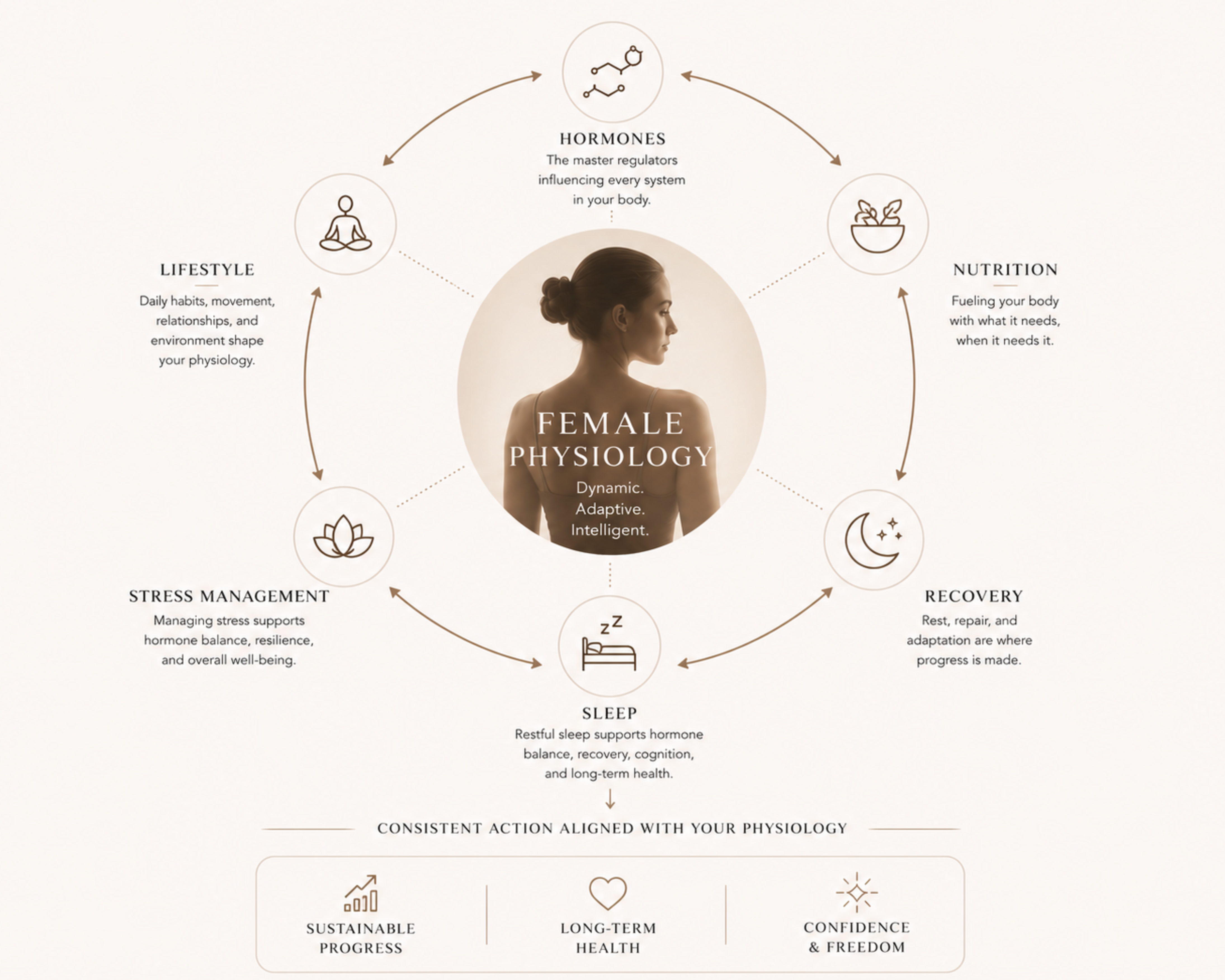
Most training advice assumes a flat, unchanging hormonal baseline — the same intensity should produce the same adaptation every single week. For women, that assumption is wrong. Estrogen and progesterone rise and fall across a roughly month-long cycle, and both hormones directly influence how your body handles training stress: how much cortisol a session produces, how efficiently your muscles repair, even how much fuel is available for hard efforts on a given day.
This means the exact same workout, at the exact same intensity, genuinely does not produce the same result every week of your cycle. Train against that reality without knowing it exists, and you can end up doing everything "right" while your body absorbs it inconsistently — sometimes adapting well, sometimes barely recovering at all.
How your cycle changes what your body can absorb from training
In the follicular phase — roughly the two weeks after your period — rising estrogen improves insulin sensitivity, supports faster muscle repair, and generally makes your body more receptive to harder training. This is when progressive overload tends to actually stick.
In the luteal phase, progesterone rises and has a mildly catabolic, higher-cortisol effect. Recovery slows, water retention increases, and the same session that felt manageable two weeks earlier can leave you far more depleted. Training exactly as hard here, without adjusting volume or intensity, is often where "I did everything right and still didn't progress" actually comes from.
What changes when your plan is built around your hormones
Phase-aware training does not mean training less. It means shifting when you push for progressive overload and when you protect recovery, so the hard weeks actually convert into progress instead of quietly compounding fatigue. At Zōē, this is the starting point of every plan — not a generic split repeated indefinitely, but a structure that moves with your actual cycle.
Alongside Andreea and Francesco's direct coaching, The Zōē Method includes access to Mr Z — an AI coaching assistant built by Francesco Zen on ZTraining's 18-year coaching methodology, available via Telegram between sessions for real-time questions on training days, travel, and nutrition choices.
Andreea Mighiu is a women's hormonal health educator and the founder of Zōē. She works alongside a registered dietitian and an endocrinologist to ensure content reflects current clinical understanding. She is an educator, not a physician — Zōē's content is designed to inform, not to replace personalised medical advice.