Why fasting works differently in women — the hormonal mechanism
Most intermittent fasting research has been conducted on men — whose hormones reset every 24 hours and who do not experience the 28-day cycle of changing cortisol sensitivity, insulin response and reproductive hormone fluctuation that women do. The results from male-dominant research were handed to women as if the biology was equivalent. It is not.
In women, fasting is a cortisol stimulus. The body reads the absence of food as a potential energy shortage and responds by elevating cortisol to mobilise stored energy. In men, this response is relatively consistent daily. In women, the cortisol response to the same fast is measurably different depending on where she is in her cycle — lowest in the follicular phase when estrogen is high and cortisol sensitivity is low, highest in the late luteal phase when both estrogen and progesterone are falling and cortisol sensitivity is at its monthly peak.
This is why a fast that felt manageable in week two produces anxiety, poor sleep and hunger that feels uncontrollable in week four. The fast has not changed. The hormonal environment has.
The HPO axis and why aggressive fasting disrupts the cycle
The HPO axis — hypothalamic-pituitary-ovarian — is the hormonal cascade that regulates the menstrual cycle. The hypothalamus produces GnRH, which signals the pituitary to produce LH and FSH, which signal the ovaries to produce estrogen and progesterone. This cascade is exquisitely sensitive to energy availability.
Research has confirmed that kisspeptin — the neuropeptide that triggers GnRH and therefore the entire reproductive cascade — is directly suppressed by fasting. A 2025 systematic review found that in women without PCOS (who have normal kisspeptin levels), fasting may decrease kisspeptin too much — and if kisspeptin gets too low it can compromise fertility and disrupt the reproductive cycle.
The result of sustained fasting-induced kisspeptin suppression is: shortened luteal phases, reduced progesterone production, anovulatory cycles (no ovulation), and eventually absent periods. These are not dramatic or sudden changes — they creep in gradually over weeks and months of aggressive fasting applied without cycle awareness.
The phase-specific approach — how to fast as a woman
Follicular phase (Days 6 to 13) — your fasting window. Insulin sensitivity is highest, estrogen is rising, cortisol sensitivity is lowest. The body is most metabolically resilient in this phase. A 14 to 16 hour fast — eating window from roughly 10am to 6pm — is generally well tolerated and produces meaningful metabolic benefits without disrupting the HPO axis. This is the phase where intermittent fasting delivers what its proponents promise.
Ovulatory phase (Days 14 to 16) — shorten the fast. Estrogen and testosterone peak. Performance is highest. Fuel it. A 12 hour overnight fast maximum. Eat to support the physical output and cognitive peak this phase provides.
Early luteal phase (Days 17 to 22) — 12 hour maximum. Progesterone is rising, metabolism is increasing. The body needs more fuel, not less. A 12 hour overnight fast — stopping eating at 8pm, eating at 8am — is the limit of what is hormonally appropriate here.
Late luteal phase (Days 23 to 28) — no fasting. Cortisol sensitivity is at its monthly peak. Progesterone and estrogen are falling. Metabolic rate is elevated. Any fasting in this window is a cortisol stimulus applied to the most cortisol-sensitive week of the cycle. It actively worsens premenstrual symptoms, disrupts sleep and promotes fat storage rather than fat loss. Eat regularly, eat enough, focus on complex carbohydrates and magnesium-rich foods.
Menstrual phase (Days 1 to 5) — no fasting. Iron replenishment after blood loss, anti-inflammatory foods, adequate calories. The body is in recovery mode. Fasting in menstruation is one of the clearest routes to HPO disruption.
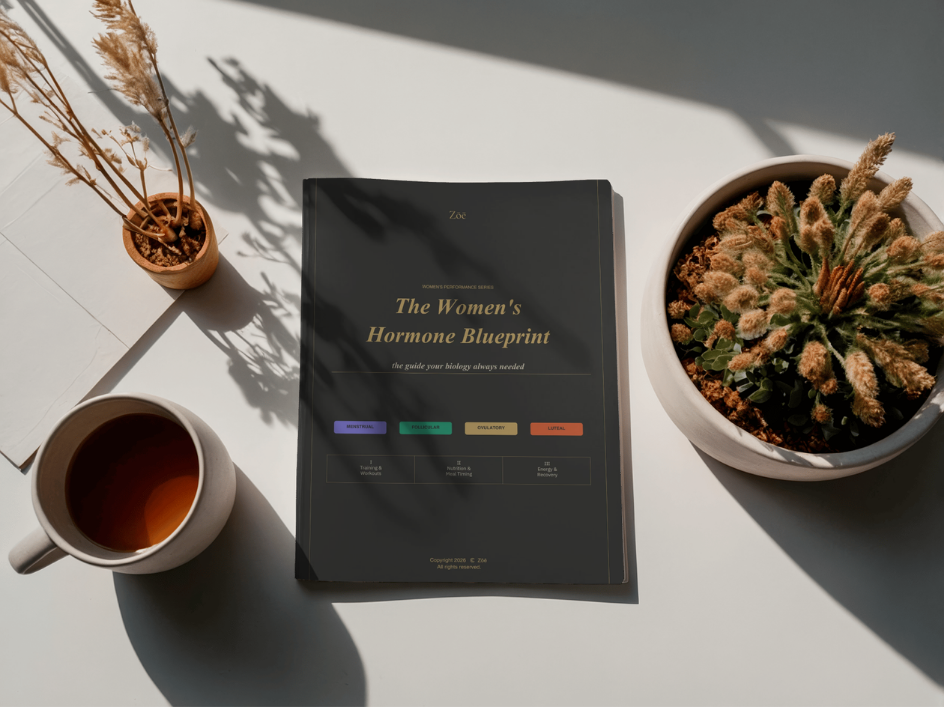
The complete phase-specific nutrition system — including when to fast, when to eat more, exactly what to eat in each phase and why — is in The Women's Hormone Blueprint. For the daily practice of tracking your energy, food and cycle phase, The Aligned Woman Journal gives you 168 unique daily pages across six complete cycles.