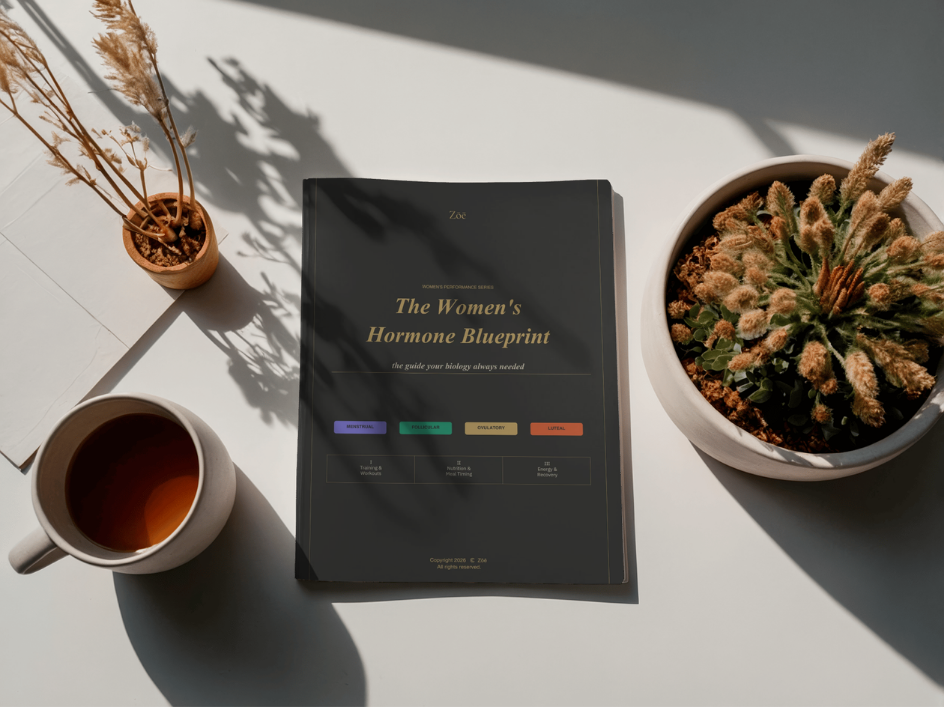
Nobody sat me down and explained what was actually happening. I got a pamphlet. Maybe a very awkward conversation. A box of pads left outside the bathroom door. And then I was just supposed to figure it out — why I felt like a completely different person every few weeks, why my skin broke out in the same spot every month like clockwork, why I wanted to cry at things that would not have mattered to me the week before.
This is the conversation I wish someone had with me. And if you are reading this — whether you just got your first period or you have had them for years and still feel confused — it is for you.
Your period is not just one thing.
It is a whole system.
Here is the thing nobody leads with: your period is actually the least interesting part of your menstrual cycle. The period — the bleeding — is just four to seven days out of a cycle that is happening every single day of the month. Your hormones are doing something different in week one, week two, week three and week four. And those differences are not random. They are a pattern. Once you know the pattern, you will never be confused by your own body again.
The four phases go like this. During your period, estrogen and progesterone are at their lowest — which is why you feel tired, inward and sometimes flat. After your period ends, estrogen starts climbing and you feel it — energy returns, your brain sharpens, you feel more yourself. Around the middle of your cycle — when you ovulate — estrogen peaks and you are at your most social, confident and clear. Then in the two weeks before your next period, progesterone rises and things get quieter, more inward, sometimes more emotional. And then it starts again.
This is not weakness. This is biology. A remarkably intelligent biology, actually.
The week before your period is the hardest.
Here is why.
In the days before your period arrives, progesterone drops sharply. Progesterone affects GABA receptors — the same receptors that anti-anxiety medication targets. When progesterone drops, GABA drops too, and your nervous system becomes measurably more reactive. Things that would bounce off you in week two land differently in week four. You are not imagining it. Your brain is in a genuinely different state.
At the same time, estrogen drops too — and estrogen supports serotonin. So you have lower serotonin, lower GABA, higher cortisol sensitivity, and disrupted sleep from the elevated progesterone that preceded the drop. The irritability, the tearfulness, the anxiety, the feeling that everything is slightly too much — it is not you losing the plot. It is a hormonal event. It has a beginning, a middle and an end. It ends when your period starts.
What helps: Knowing it is coming. Reducing caffeine in the last week of your cycle. Magnesium glycinate at 375mg daily is one of the most evidence-backed interventions for premenstrual symptoms — it reduces uterine cramping by relaxing smooth muscle, supports GABA activity to reduce anxiety, and improves sleep quality. Most women do not reach 375mg from food alone, so supplementing directly in the luteal phase makes a real difference. B complex vitamins — particularly B6 and B1 — have strong evidence for reducing both period pain and PMS mood symptoms. B6 supports serotonin production and B1 reduces prostaglandin activity. Take B complex daily throughout your cycle and you will notice the difference within one to two months. Heat, gentle movement, and anti-inflammatory foods like salmon, walnuts and ginger all help alongside these.
The cramps are not normal if they are stopping you from living.
Mild cramps — yes, normal. A bit of discomfort on day one — normal. Cramps that make you miss school, curl up on the floor, or vomit — not something you have to accept as just how it is. Period pain is caused by prostaglandins, and in some people those prostaglandin levels are genuinely high enough to cause severe pain. There are things that help. There are also conditions — like endometriosis — that can start in teenage years and are frequently dismissed as normal period pain for years before being diagnosed.
If your cramps are severe, say so. Tell a parent. Tell a doctor. Push back if you are told it is fine or that you just have a low pain threshold. You know what you are feeling.
Your cycle will be irregular at first.
That is not a problem.
In the first one to three years after your first period, your hormonal system is still calibrating. Ovulation does not happen consistently. Cycles might be 28 days one month and 45 days the next. You might miss a cycle entirely. This is your body learning a new language — it takes time and some initial inconsistency is part of the process.
Where it is worth paying attention: if your periods stop entirely for more than three months after they were regular, if they are consistently extremely heavy, or if the pain is severe enough to significantly affect your life. These deserve medical attention not because something is definitely wrong but because you deserve answers.
The skin thing is real and it is hormonal.
The breakouts along your jaw and chin in the week before your period — that is testosterone becoming relatively more dominant as estrogen and progesterone drop. Testosterone stimulates sebum production. More sebum equals more blocked pores. This is why the same spots tend to appear in the same week every single month. It is not random and it is not about how often you wash your face.
Reducing sugar and dairy in the premenstrual week helps for many people. For topical care, niacinamide — vitamin B3 applied to the skin — reduces sebum production, calms inflammation and visibly reduces hormonal breakouts without stripping the skin. Look for a 5 to 10 percent niacinamide serum and apply it daily. Salicylic acid is another option — it works inside the pore to dissolve the buildup that causes breakouts, making it particularly effective on the jaw and chin where hormonal acne clusters. Use it as a targeted treatment on active spots rather than all over the face. If hormonal acne is significantly affecting your confidence and quality of life, it is worth talking to a dermatologist. There are effective treatments and you do not have to wait it out.
Tracking your cycle is the most useful thing you can do right now.
You do not need a complicated system. A simple app where you mark day one of your period every month and note your energy and mood each day is enough. Within two to three months you will start to see your pattern. You will notice that you always feel better the week after your period. That you are more social and capable in the middle of your cycle. That the week before is always harder. That the spots always come at the same point.
When you can see the pattern, the hard days stop being confusing. They stop feeling like something is wrong with you. They just become information. And information is something you can work with.
This is what most women do not learn until they are in their 30s. You can have it now. It changes everything about how you understand yourself.